
Underarm ingrown hair mainly occurs when the hair, commonly after shaving or tweezing, grows back into the skin instead of growing out. As the hair becomes curled under the skin, the body starts reacting to it. You may feel itchy, tender, or slightly painful, often looking similar to a pimple.
Armpit ingrown hair is one of the most commonly faced issues and tends to appear in skin that is prone to sweating. Often, lack of proper moisturizing, improper hair removal, and constant friction through tight and synthetic fabrics cause the ingrown hair.
However, you need to follow some precise techniques to remove this hair, like exfoliation and compressions with warm water for 10–15 minutes a few times a day.
Read our complete overview on underarm ingrown hair, which clearly highlights the signs, risks, reasons, with the best treatment, and prevention suggestions from an expert end.
What Is Underarm Ingrown Actually?
Underarm ingrown is mainly hair that curls and grows back into the skin instead of growing out from the hair skin follicles. Due to this, you can experience red, tender, or pimple-like bumps that are often inflamed and painful. Even trapped sweat and friction make things worse.
Normally, hair grows through the hair follicle and comes out of the skin. But sometimes dead skin cells block the opening of the follicle. When that happens, the hair never fully breaks through the skin and gets trapped under the thin layer of the skin and dead skin cells. It curls back to the surrounding tissue.
This can cause mild swelling, tenderness, or itching. At worst, the bump may become more painful, red, or filled with pus. But many ingrown hairs in the underarm heal on their own in a few days to a couple of weeks.
In case you notice deep, hard lumps, it is a clear sign of a more stubborn follicle issue or even a small cyst that needs quick medical treatment.
What Are the 5 Major Causes of Ingrown Hairs?
The common reason for ingrown hairs coming back is improper hair removal and clogged hair follicles. Often, if you have genetically coarse or curly hair, it bends back to the root.
1. Removing hair against the grain:
Shaving, waxing, and tweezing are the main reasons for causing ingrown hairs. The problem starts when you shave against the grain. Here, the razor cuts the hair very close and leaves a sharp and angled tip. Due to this, when the hair starts growing back, it comes to push and bend into the skin instead of growing straight out.
2. Biological hair texture:
Researchers found that people with thick, coarse, or curly hair have a higher chance of getting ingrown hairs. Curly hair often grows curved from the root.
So instead of growing straight out of the skin, it grows bent back into the skin. This is common for people with coarse, curly, or afro-textured hair, especially in shaved areas like the face, legs, and underarms.
3. Dead skin cell buildup:
When dead skin cells build up on the skin’s surface, they can easily clog and block the opening of the hair follicle. Due to the blockage, the hair can’t come out normally through the skin. So instead of growing out, it gets forced to grow sideways under the skin.
4. Wearing tight clothing and constant friction:
According to the Healthdirect report, wearing tight clothing and constantly rubbing in the underarm area can increase ingrown hairs. When clothing fits tighter than usual, it presses and rubs against the skin. This becomes worse when you have just done a shave or wax. At that time, new hair is trying to grow out. But constant pressure from clothing can push the hair back into the skin.
5. Clogged Follicles from Product Buildup:
When you are continuously using deodorants, antiperspirants, or dry shampoos, it leaves a thin layer of residue on your skin. This residue partially blocks the opening of the hair follicles. This makes the new hair have a harder time growing out normally and causes ingrown hair.
Common Signs of Ingrown Armpit Hair
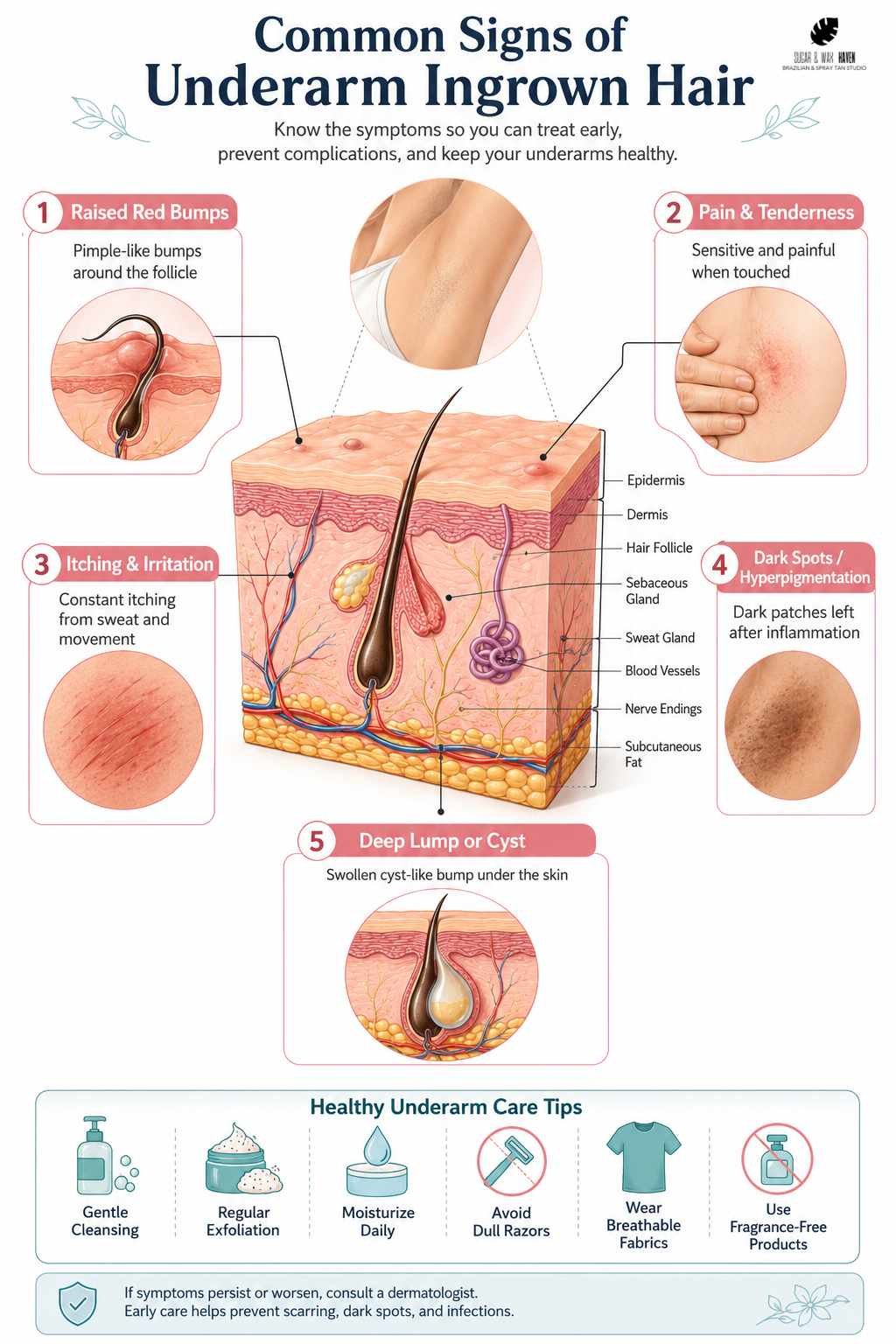
When underarm ingrown hair comes, you will see raised red or often skin-colored bumps. Moreover, it will cause itching, tenderness, and severe pain if bacteria get into that place. In more severe cases, the bump can grow larger and last for several days. Often it turns into a small abscess that requires treatment.
Let’s have a quick overview of some common signs in this instance:
- A small, raised bump appears in the area, which is mostly like a pimple. You may spot a tiny dark dot at the center, which is the trapped hair.
- You will feel pain when you touch it. Here, even minor pressure makes the area feel tender, causing irritation and inflammation.
- There will be constant itching around the hair follicle. The itching often feels worse because of sweat, heat, and friction from arm movement.
- If it is not treated properly and at the right time, chances are it can leave dark patches on the skin. This is called hyperpigmentation.
- Over time, fluid, oil, and dead skin cells can build up inside the follicle. This causes a firm lump deeper under the skin, sometimes called a cyst.
How To Get Rid of Ingrown Hair on the Underarm?
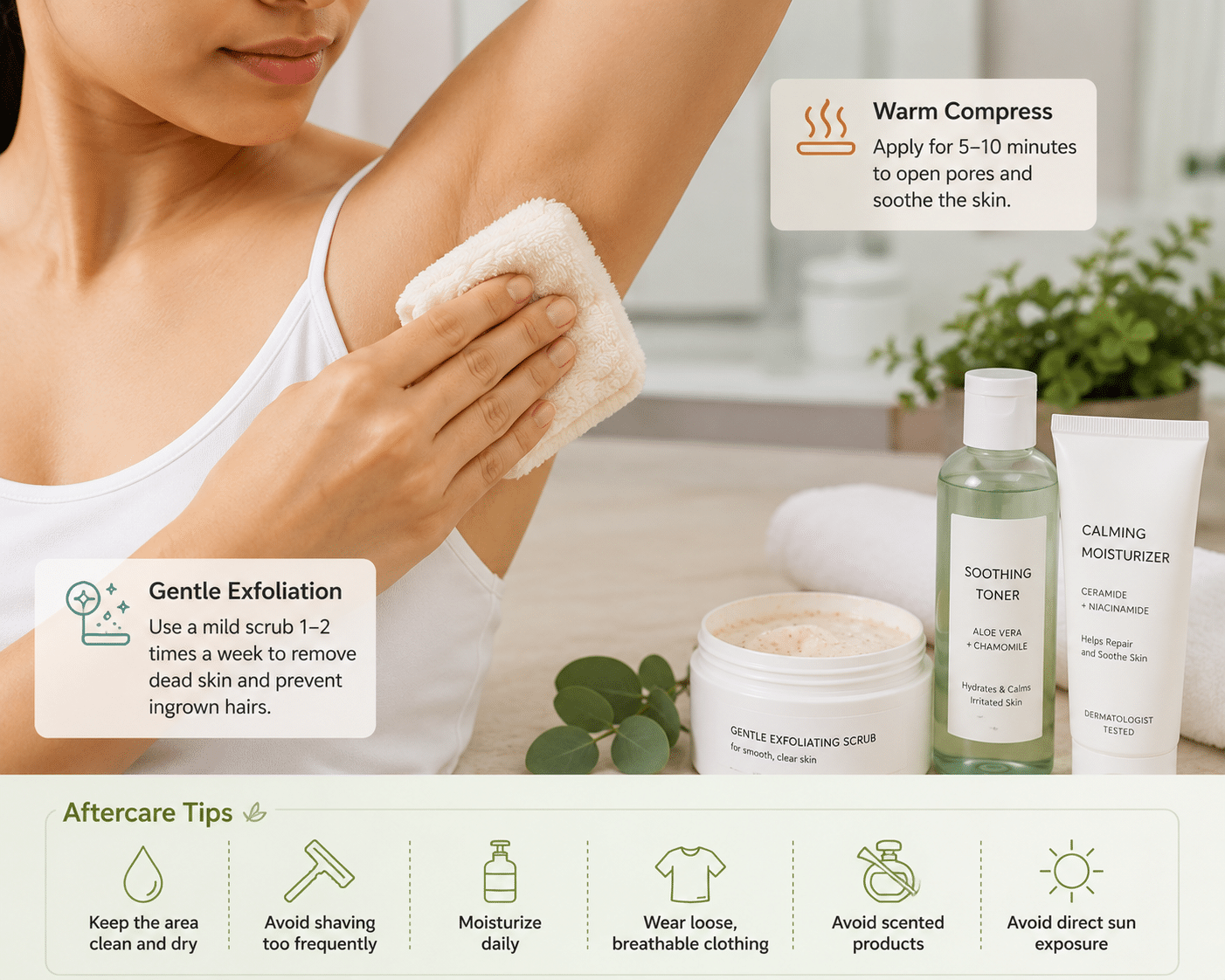
To remove the ingrown hair, compress the area with warm water and gently exfoliate the skin using a soft cloth. You can use an exfoliating gel or scrub, or any other chemical exfoliant, for better results. Warm water helps soften the skin and helps release it more effectively.
Underarm ingrown hair using a warm compress and gentle exfoliation.
Follow the steps below to effectively treat the underarm ingrown hair:
Stop shaving/waxing the area
As for the first step, you have to stop shaving and waxing the area. If you continue to shave over an active ingrown hair, it will further irritate the area. Dermatologists often suggest taking a break from shaving for about 30 days so the skin can heal. During this time, the trapped hair may naturally come out on its own without extra irritation.
Don’t pick or squeeze
Beyond shaving, you should not pick, squeeze, or pop an ingrown hair bump. Even though you may find it tempting, doing so can make things worse. When you squeeze it, it can push bacteria deeper into the skin and increase the risk of infection.
According to NYU Langone dermatologists, poking or tweezing at home almost always introduces new bacteria to the area. Even germs can enter, potentially leading to more inflammation.
Apply a warm compress
Next, you should use a warm, wet cloth on the bump to help it heal. When you are placing a warm compress, it helps in a few ways:
- It increases blood flow to the area, which helps healing
- It softens the skin over the trapped hair
- It makes it easier for the hair to move closer to the surface of the skin
Dermatologists recommend applying a warm compress for about 10 to 15 minutes a day. After a few days, the trapped hair may come closer to the surface. It can then come out naturally or be safely released without damaging the skin.
Gentle Exfoliation
After using the warm compress, you will start lightly cleaning the skin around the bump to help it heal. Just gently rub the area with a soft washcloth and do it in small circular motions. This way, you can easily remove dead skin cells that may be blocking the hair follicle.
But it’s very important to be gentle. If you scrub too hard, you can:
- Increase redness
- Make the swelling worse
- Slow down healing
Use Salicylic Acid or Benzoyl Peroxide
Ingrown hairs can easily develop into folliculitis, which causes inflammation and pain over time.
Dr. Mara Weinstein Velez, a board-certified dermatologist and assistant professor at the University of Rochester Medical Center, confirms that products with benzoyl peroxide and salicylic acid help exfoliate the dead cells in the skin around and on top of the ingrown hair.
She recommends using these treatments twice a day. These products help unclog the skin and calm the bump. This way, you will find that the hair can easily come out. Even if it makes the ingrown hair less likely to grow again.
Carefully Remove the Visible Hair
When you find the hair clearly visible just beneath or at the skin surface, you can remove it. For instance, you can use a fine-tipped needle. Before using it, you must sterilize it with rubbing alcohol.
Gently use it to lift the trapped loop of hair upward so it comes out of the skin opening. Never pull or pluck the entire hair out. Dermatologists mostly suggest using this method over tweezers. You can easily grab and pull the whole hair from the root. It can even make future ingrown hairs more likely.
Apply an Antiseptic
Once you gently lift a visible ingrown hair out of the skin, clean the area afterward. This is important as the follicle opening may stay slightly open for a short time, where bacteria can easily enter. For this reason, there are a few products you can apply. Such as:
- Rubbing alcohol → helps disinfect the skin
- Diluted tea tree oil → may help reduce bacteria and irritation
- An over-the-counter antibiotic ointment like Neosporin. → helps lower infection risk
The underarm is a high-sweat zone. So try to keep the area clean and dry for the next 24 hours.
Treat Inflammation
Even after the hair is released, the follicle stays open for a short time, causing irritation. You may see redness, swelling, or tenderness for a while.
“Hydrocortisone creams can help reduce inflammation and itching associated with ingrown hairs.”
– says Dr. Y. Claire Chang, a board-certified cosmetic dermatologist at Union Square Laser Dermatology in Manhattan.
For instance, apply a thin layer of 1% hydrocortisone cream. It helps calm the redness and swelling. If the bump was pus-filled or particularly inflamed, use benzoyl peroxide, which helps reduce bacteria and speed up healing. It can easily help reduce inflammation.
Home Remedies for an Ingrown Armpit Hair
Tea tree oil, aloe vera, apple cider vinegar, and even honey are excellent natural ingredients to treat the infection and help prevent it.
Scroll down to get to know in detail:
1. Tea Tree Oil
Tea tree oil contains terpinen-4-ol, an active ingredient in it that works as an inflammatory mediator. It will directly help reduce the inflammatory response around the follicle.
Even beyond this, it carries antimicrobial, antibacterial, antifungal, antiviral, and anti-inflammatory properties that help heal the process. Just apply it with jojoba, grapeseed, or sweet almond oil at a ratio of 1 drop of tea tree oil to 12 drops of carrier oil. Use a cotton swab and apply the mixture to the ingrown hair gently.
2. Aloe Vera
Aloe vera contains active healing and cooling properties that will help you soothe irritated skin and reduce inflammation. Almost every one of our houses has this, and it can be a quick way to get comfort.
It is even easier to apply. Just apply pure aloe vera gel directly to the affected area several times daily. It not only soothes the irritation, but also the redness, and helps in faster healing.
3. Warm saltwater or Epsom salt compress
An Epsom salt compress is an excellent and easy way to treat ingrown hair. Basically, magnesium sulfate in Epsom salt has anti-inflammatory properties. This is the one that reduces swelling and redness.
You can even use it as a gentle exfoliant, loosening dead skin cells that are hidden in the hair follicle. Stir 1 to 2 teaspoons of Epsom salt into 1 cup of warm water until completely dissolved. Now dip a cotton pad into it and press the warm cloth directly over the ingrown hair. Do it for 10 to 15 minutes for maximum comfort.
4. Aspirin paste (for mild inflammation)
Aspirin paste is another readily available element that you can apply as the treatment for ingrown hair. It contains salicylic acid, which can help to exfoliate the skin. Even you will feel reduced inflammation. It basically softens the skin cells, and its anti-inflammatory properties help in quick healing.
Crush 3 to 4 plain uncoated aspirin tablets. Then mix with a small amount of water to form a paste. Apply it in the place and wait until it dries.
5. Apple Cider Vinegar
Apple cider vinegar’s main active ingredient is acetic acid. This will reduce inflammation and discomfort. Soak a cotton round with apple cider vinegar. Now dab it on the affected area. After 10 to 15 minutes, wash the area with water.
6. Baking Soda
This works as a mild exfoliant, which is excellent for reducing redness. The anti-inflammatory properties of it even help in calming the inflammation. Mix 1 tablespoon of baking soda with a cup of water. Apply the paste to the affected skin and leave for 5 to 8 minutes. Wash off with water.
7. Honey
Honey contains anti-oxidant, anti-bacterial, and anti-inflammatory properties that also work best in improving healing. Apply a thin layer of raw honey directly to the bump. Just leave it for 15 to 20 minutes, then rinse with warm water.
Best Skincare Habits for Ingrown Armpit Hair Prevention: Tips That Actually Work
- Regularly exfoliate your skin to prevent dead skin buildup. Before shaving, use a gentle scrub or chemical exfoliant with AHAs or BHAs. After hair removal, wait at least 24 hours before exfoliating again.
- Always shave in the direction of the hair growth. Also, don’t apply too much pressure when shaving.
- Most skincare experts recommend replacing the razor blade every 5 to 7 shaves to prevent skin irritation and ingrown hair.
- Avoid shaving dry underarms, and ensure to use a shaving cream or gel to help the razor glide smoothly. This even lowers the risk of skin pimples and trapped hairs.
- Moisturize your skin properly right after shaving. If you frequently get ingrown hairs, consider formulas with salicylic acid.
- Keep note that freshly shaved skin is sensitive and the chances of irritation are higher. So it is better to wait at least 10 to 20 minutes after shaving before applying deodorant.
- Skip wearing tight clothing where the chances of sweat trapping around the follicles are higher. The day you shave or wax, always wear loose cotton fabrics.
- Always keep the underarm area dry and clean. Wash your underarms daily with a gentle cleanser and dry the area well afterward. Avoid harsh soaps that strip the skin.
- If ingrown hairs keep coming back despite you having done everything above, always shaving can be one reason. The better option will be switching to sugaring to remove the hair effectively.
- In a professional sugaring service through expert hands, you can extract the hair in the natural direction of its growth. That saves the hair from breaking out unnaturally under the skin surface and prevents ingrown hair growth. The process is even more effective in reducing inflammation and irritation.
- Also, most often, shaving cuts the hair bluntly at the surface and makes it likely to curl back in again. The better option will be to switch to professional waxing services, which completely remove hair from the follicle. Moreover, the built-in exfoliation keeps follicles clear and makes it harder for hair to become trapped again.
Looking for Best Expert Guidance to Treat Underarm Ingrown Hair?
Underarm ingrown hair is frustrating, but the good news is that it is preventable. All you need to do is follow the right hair removal method under expert hands. With the professional hair removal technique according to your skin type, it can make a real difference and help prevent ingrown hair.
At Sugar Wax Haven, our licensed estheticians customize every underarm treatment to your skin type. Book your appointment today and stop the ingrown hair cycle for good.
Frequently Asked Questions
Is Ingrown Hair Contagious?
No, ingrown hairs are not contagious. This happens when the hair curls and grows back into the skin instead of growing outward. However, mild to severe inflammation cannot spread to another person.
Can deodorant cause underarm ingrown hairs?
Yes, deodorant can cause ingrown hairs. Often, heavy deodorants or antiperspirants contain waxes and aluminum that clog hair follicles. This traps hair under the skin and can lead to ingrown hairs.
How long does an underarm ingrown hair take to heal on its own?
Most underarm ingrown hairs heal within one to two weeks. Minor bumps usually heal within a few days to a week. But more irritated or infected hairs may take longer, typically 7 to 10 days.