
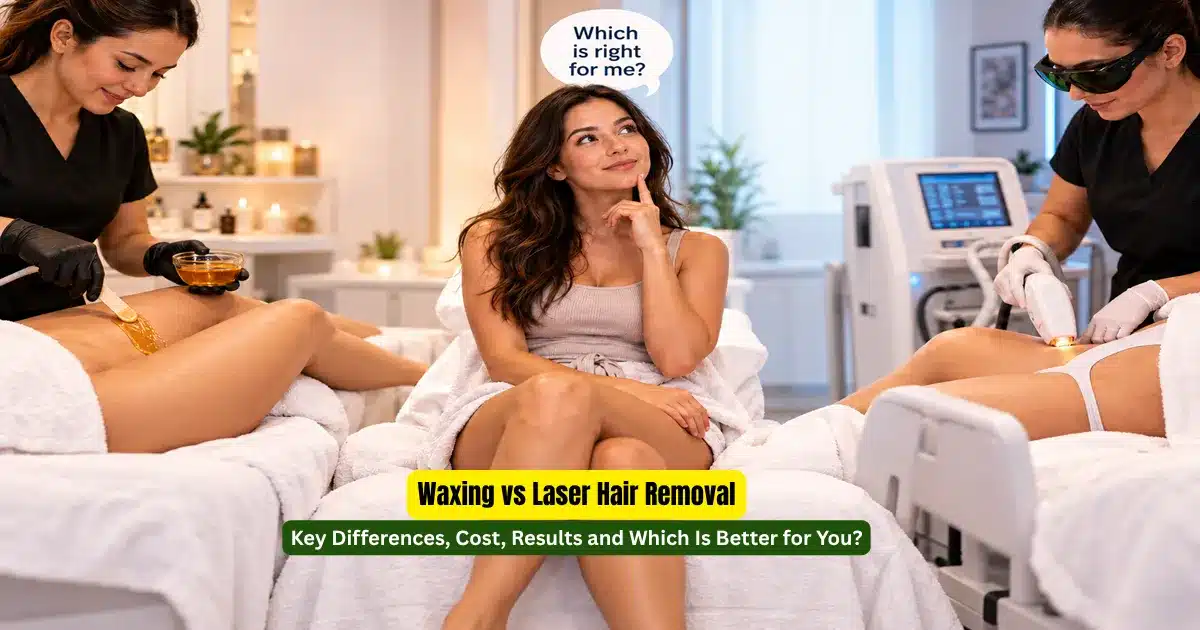
Waxing removes hair at the root and lasts 3-6 weeks. Laser hair removal uses targeted light energy to damage the hair follicle, reducing regrowth by 70-90% over 6-8 sessions. Waxing suits all hair colors, laser does not work on white, gray, or very light blonde hair.
Waxing averages about $50 per session, while laser averages about $200 per session. At Arizona, we do Brazilian waxes for clients who switched from laser mid-course because the sessions were spaced too far apart and they could not stand the waiting period.
We also see the opposite: people who waxed for years and are finally done with the monthly cycle.
Both methods work. Which one is right for you depends on budget, hair color, skin type, and how permanent you want your results to be. Here’s what we cover below.
Key Takeaways
- Waxing removes hair immediately and lasts 3-6 weeks.
- Laser hair removal reduces regrowth over multiple sessions.
- Waxing works across all hair colors and skin tones.
- Laser works best on dark, pigmented hair.
- Laser requires multiple sessions and ongoing maintenance.
- Waxing costs less upfront but requires repeated appointments.
- Both methods can cause temporary redness and sensitivity.
Waxing vs Laser Hair Removal: Side-by-Side Comparison
If possible, add a shorter, clear, concise table with core differences as a table on an image infographic.
Waxing removes hair immediately, while laser offers longer-term reduction. The table below highlights their core differences in cost, results, pain, maintenance, and more.
| Factor | Waxing | Laser Hair Removal |
| How it works | Wax grips the hair and pulls it from the root. | Light energy targets pigment in the hair and heats the follicle to reduce future growth. |
| Main goal | Removes existing hair for temporary smoothness. | Provides long‑term reduction in hair growth. |
| Results | Skin feels smooth immediately after treatment. | Hair sheds over the following days or weeks, and growth is reduced across multiple sessions. |
| How long results last | Usually 3-6 weeks, depending on the area and growth rate. | Results can last much longer after a full course, but maintenance may still be needed. |
| Upfront cost (Arizona) | Usually $30-$90 per session. | Often $150-$500 per session, package prices vary by area and provider. |
| Long‑term cost | Ongoing expense because treatments must be repeated. | Higher upfront investment, with potentially lower recurring costs over time. |
| Pain | A quick, sharp sting when hair is pulled from the root. | Often feels like brief snaps or pinpricks, cooling can improve comfort. |
| Sessions needed | Repeated every few weeks for continued smoothness. | Usually requires multiple sessions because hair responds best during certain growth phases. |
| Regrowth | Hair grows back according to its normal growth cycle. | Regrowth usually becomes less dense or finer after successful treatment. |
| Hair color | Works on virtually all hair colors, including blonde, gray, and white. | Works best on pigmented hair, white, gray, and very light hair may not respond. |
| Skin tone | Can be used across skin tones when performed correctly. | Suitable for many skin tones, but laser type, settings, and provider experience matter. |
| Ingrown hairs | May contribute to ingrown hairs, especially with coarse or curly hair. | May reduce ingrown hairs as hair growth becomes less dense. |
| Preparation | Hair needs enough length for the wax to grip. | Shaving is commonly recommended, waxing and plucking are usually avoided beforehand. |
| Sun exposure | Recently waxed skin can be more sensitive to irritation and sun exposure. | Sun exposure and tanning require careful management before and after treatment. |
| Maintenance | Requires regular appointments for continued smoothness. | Maintenance treatments may be needed after the initial course. |
| Downtime | Usually minimal, though temporary redness or irritation can occur. | Usually minimal, though temporary redness, swelling, or sensitivity can occur. |
| Side effects | Possible redness, irritation, ingrown hairs, or skin lifting. | Possible redness, swelling, irritation, or temporary pigment changes. |
| Treatment frequency | Commonly every 3-6 weeks, depending on regrowth. | Sessions are usually spaced several weeks apart based on the area and growth cycle. |
| Hair‑growth cycle | Removes hair regardless of its current growth phase. | Works best when hairs are in the active growth phase targeted by the laser. |
| Treatment speed | Provides visible smoothness immediately after treatment. | Treatment is relatively quick, but results develop gradually. |
| Body‑area suitability | Can treat many areas, including legs, underarms, bikini areas, and face. | Can treat many body areas, though some require special consideration. |
| Long‑term commitment | Requires ongoing appointments with no defined endpoint. | Requires an initial treatment course followed by maintenance when needed. |
| Pregnancy | Generally considered an option, but check with your healthcare provider. | Generally avoided because safety data during pregnancy are limited. |
| Best for | Immediate smoothness, lower upfront cost, and all hair colors. | Long‑term hair reduction, especially when hair has enough pigment to respond. |
What Is Waxing?
Waxing pulls hair out from the root using warm soft wax or hard wax. Results last 3-6 weeks. Then the follicle produces a new hair, and the cycle starts again. The wax bonds to the hair shaft. When the esthetician removes it in the direction opposite to growth, the entire hair comes out, root included.
Wax adheres to the hair shaft, not the skin. Removing it in one firm motion extracts the hair from the follicle. No follicle damage means hair grows back fully within 3-6 weeks.
Benefits of Waxing
There are several benefits of waxing, core benefits are:
- Works on every hair color, including white, gray, and light blonde
- Works on all skin tones with the right wax type and temperature
- Results are visible after one session
- Lower upfront cost per visit ($30-$90)
- Regular sessions can thin regrowth over time for some clients
- Safe during pregnancy for most body areas; check with your OB for intimate zones
- A session takes 15-45 minutes depending on area
- The strip removal also exfoliates the top skin layer
Limitations of Waxing
Several limitations also noticed:
- Results are temporary- hair grows back fully
- You need at least 1/4 inch of growth (10-14 days) before each session
- Coarse or curly hair types are more prone to ingrowns
- No endpoint, cost continues indefinitely
- The strip pull stings, especially in sensitive areas like the Brazilian zone
- Burns can happen if wax temperature is not controlled
- Redness and mild swelling are normal for 24-48 hours after
- Avoid waxing if you use retinoids, Accutane, or recently had a chemical peel
What Is Laser Hair Removal?
Laser hair removal uses concentrated light absorbed by the melanin in your hair follicle. The heat destroys the follicle’s ability to regrow hair. The FDA classifies this as permanent hair reduction, not permanent hair removal.
The laser targets melanin specifically. So it works on dark hair. Light, gray, white, or red hair lacks sufficient melanin to absorb laser energy.
Most people need 6-8 sessions spaced 4-6 weeks apart. That spacing covers different hair growth phases: anagen (active), catagen (transition), and telogen (resting). Laser only works on hair in the active anagen phase, which is why one session is never enough.
Benefits of Laser Hair Removal
- 70-90% hair reduction after a full course (per the American Academy of Dermatology)
- Ingrown hairs reduce significantly over time
- Costs less long-term than a lifetime of waxing
- You can shave between sessions (no need to grow hair out like with waxing)
- Nd:YAG lasers are safe for darker skin tones (Fitzpatrick IV-VI)
- Sessions run 10-60 minutes depending on the area
- Results hold for 12-24+ months after the initial course
- Each session progressively thins and softens regrowth
Limitations of Laser Hair Removal
- Does not work on white, gray, red, or very light blonde hair
- Higher upfront cost: $600-$1,500 for a Brazilian course in Arizona
- Requires 6-8 sessions before you see the full outcome
- Temporary redness and sensitivity after each session
- Risk of hyperpigmentation with older diode devices on darker skin
- No sun exposure or tanning 4 weeks before and after each session
- Not recommended during pregnancy
- Hormonal shifts (PCOS, pregnancy, menopause) can reactivate follicles later
Which Is More Painful: Waxing or Laser Hair Removal?
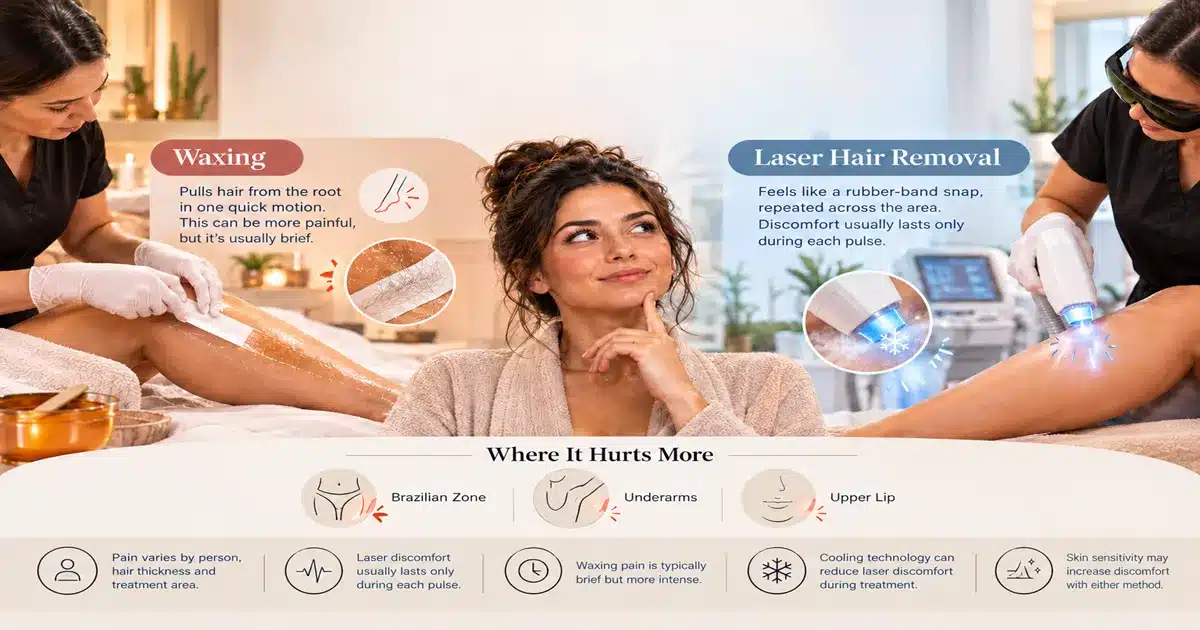
Waxing is usually more painful than laser hair removal because it pulls hair from the root in one quick motion. Laser feels like a rubber-band snap, repeated across the area. Most devices have a built-in cooling tip, which helps between pulses. Neither is unbearable. The body area matters more than the method- the Brazilian zone, underarms, and upper lip hurt more with both.
- Pain varies by person, hair thickness, and treatment area.
- Laser discomfort usually lasts only during each pulse.
- Waxing pain is typically brief but more intense.
- Cooling technology can reduce laser discomfort during treatment.
- Skin sensitivity may increase discomfort with either method.
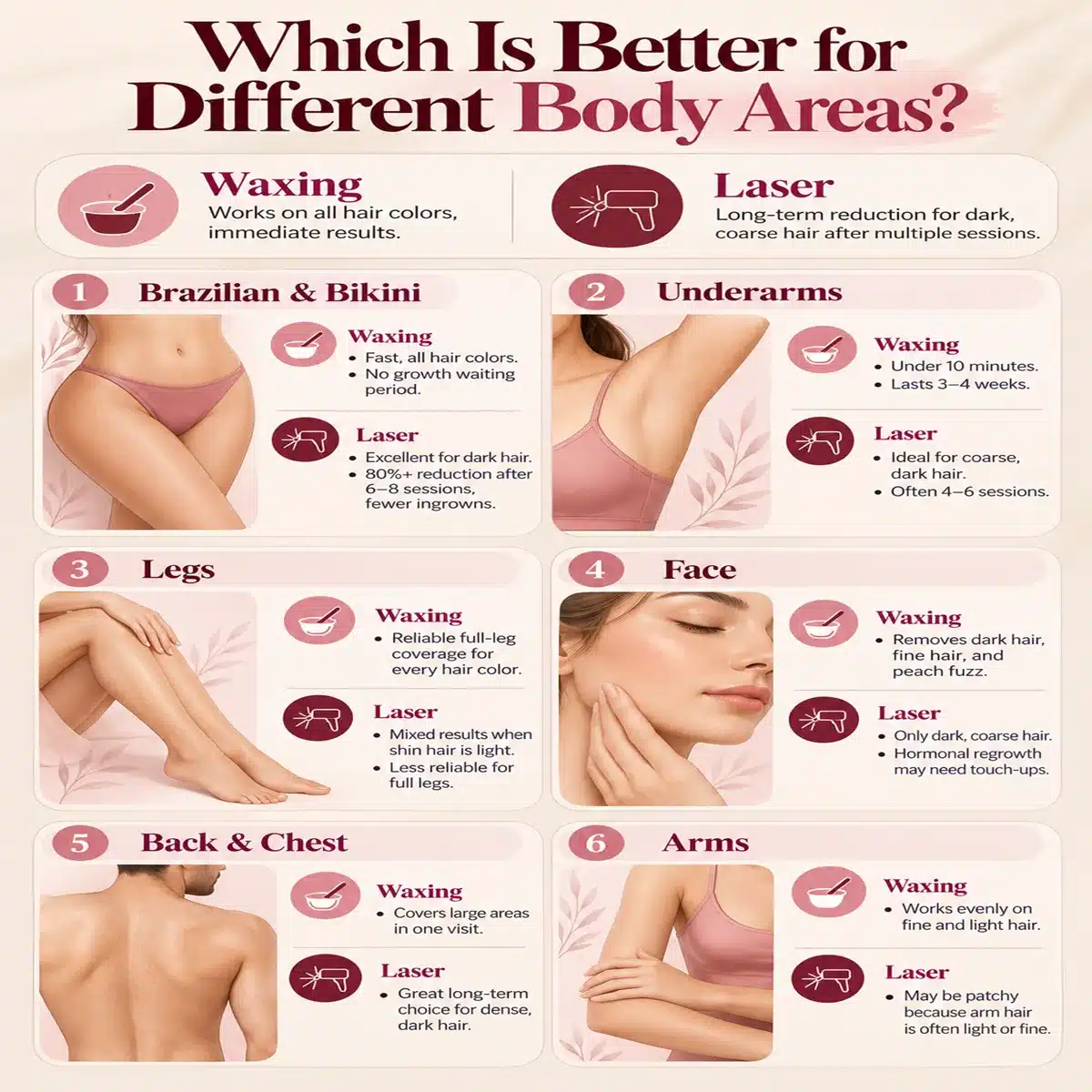
Which Is Better for Different Body Areas?
Waxing works on every area and every hair color right now. Laser beats it in the long term, but only on dark hair and only after several sessions. Here is how it breaks down by area.
Brazilian and Bikini
Waxing is fast (15-30 minutes), works on all hair colors, and has no growth waiting period. Professional waxing with hard wax minimizes discomfort in this sensitive area. Laser is effective here for dark hair. Most clients see an 80%+ reduction after 6-8 sessions, with far fewer ingrowns and no further monthly bookings.
Underarms
Waxing takes under 10 minutes and lasts 3-4 weeks. Laser works especially well here because underarm hair is usually coarse and dark. Most people only need 4-6 sessions for lasting results in this small area.
Legs
Waxing covers full legs in 30-45 minutes and works on all hair colors, including lighter shin hair. Laser struggles with mixed hair colors- thigh hair is usually darker, shin hair is often lighter. Lighter hair does not respond well. For full-leg coverage, waxing is more reliable.
Face
Waxing handles all facial hair, including fine peach fuzz. The laser targets only dark, coarse facial hair and cannot treat light or vellus hair. Hormonal changes can also bring new growth back after laser is complete, which means ongoing touch-ups.
Back and Chest
Waxing covers large areas in one session. Laser is a practical choice for dense, dark back hair, an area that is genuinely hard to maintain any other way.
Arms
Arm hair tends to be finer and lighter. Waxing works on all of it. Laser is inconsistent here and can leave patchy spots where lighter hair did not respond.
Waxing vs. Laser Hair Removal Cost (Arizona, 2026)
Individual salon and clinic pricing varies; ranges reflect typical 2026 market rates.
| Service/area | Waxing (per session) | Laser (per session) | Laser (full course estimate, 6-8 sessions) |
| Brazilian | $45-$80 | $150-$300 | $900-$1,800 |
| Bikini line | $30-$55 | $100-$200 | $600-$1,200 |
| Underarms | $20-$35 | $75-$150 | $450-$900 |
| Full legs | $65-$100 | $200-$400 | $1,200-$2,400 |
| Half legs | $40-$65 | $120-$250 | $720-$1,500 |
| Full back | $55-$90 | $200-$450 | $1,200-$2,700 |
| Upper lip | $12-$20 | $50-$100 | $300-$600 |
| Full face | $40-$70 | $150-$300 | $900-$1,800 |
| Full arms | $45-$70 | $150-$300 | $900-$1,800 |
Common Problems with Hair Removal and How Professional Waxing Helps
Most problems come from three things: technique, timing, and waxing aftercare. Professional waxing helps prevent ingrown hairs, reduce irritation, improve consistency, and minimize pigmentation through proper technique, timing, preparation, and aftercare.
Ingrown Hairs
Hair curls back when it breaks at the surface instead of pulling from the root. At-home waxing and shaving do this regularly.
Hard wax pulls the full shaft from the follicle. Add exfoliation 24 hours before your appointment and ingrowns drop fast. Curly, coarse hair sees the biggest improvement.
Skin Irritation and Redness
Some redness is normal. It clears in 24-48 hours. If it stays longer, the wax was too hot, the strip came off the wrong direction, or you had lotion on your skin beforehand.
We test wax temperature on the wrist before every client. Prep matters as much as technique. And clear you of one thing that professional waxing differs from at-home waxing.
Inconsistent Results
Hair grows in three phases: anagen (active), catagen (transition), telogen (resting). Each session only catches hairs above the skin at that moment.
Wait too long between visits, and you get patchy results. Book every 4-6 weeks. By session four, most clients stay smooth noticeably longer.
Dark Spots After Waxing
Post-inflammatory hyperpigmentation (PIH) is more pronounced in Fitzpatrick IV-VI skin tones. Main causes: wax too hot, skin overstretched, or sun exposure within 48 hours post-wax.
Stay out of the sun for 48 hours after. Apply aloe or mild hydrocortisone right after your session. Already have darkening? Have a professional look before your next booking.
FAQs
Waxing vs Laser Hair Removal: Which Is More Effective?
Laser is more effective long-term. It targets the follicle with light energy, producing 70-90% permanent hair reduction after 6-8 sessions. Waxing pulls hair from the root but leaves the follicle intact, so hair fully regrows in 3-6 weeks.
Can You Wax Between Laser Hair Removal Sessions?
No. Waxing removes the follicle the laser needs to target. Shave only between sessions.
Can You Get Laser Hair Removal After Waxing?
Yes, but stop waxing 4-6 weeks before your first session. The follicle must be intact and in the anagen phase when the laser fires, or the treatment won’t work.
Waxing vs Laser Hair Removal: Which Is Better for Sensitive Skin?
Professional hard wax at a controlled temperature is the safer option for sensitive skin. Laser can cause redness, swelling, or pigmentation changes, and those reactions tend to be more pronounced in reactive skin types.
Is Laser Hair Removal Permanent?
The FDA classifies it as permanent hair reduction, not removal. Most people keep 70-90% less hair for years, but hormonal shifts like pregnancy or menopause can reactivate dormant follicles. An annual touch-up usually handles it.
Can I Get Laser After Years of Waxing?
Yes. Waxing does not cause lasting follicle damage. Stop waxing- switch to shaving. Wait 4-6 weeks, and the follicles are ready.
Which Is Better for Brazilian Hair Removal: Waxing or Laser?
Waxing works on every hair color, in one appointment, right away. Laser takes 6-8 sessions and only works on melanin-containing hair. White, gray, and very light blonde won’t respond. If your hair is dark and you’re done with monthly appointments, laser hair removal wins in the long run.
Stop the Monthly Wax Cycle or Master It
Waxing works on every hair color, costs less upfront, and gives you smooth skin the same day. Laser cuts regrowth by 70-90% over 6-8 sessions but only works on dark hair.
At Sugar Wax Haven in Tempe, our licensed estheticians have done 6,000+ treatments. The first Brazilian is $30. Call or book online.