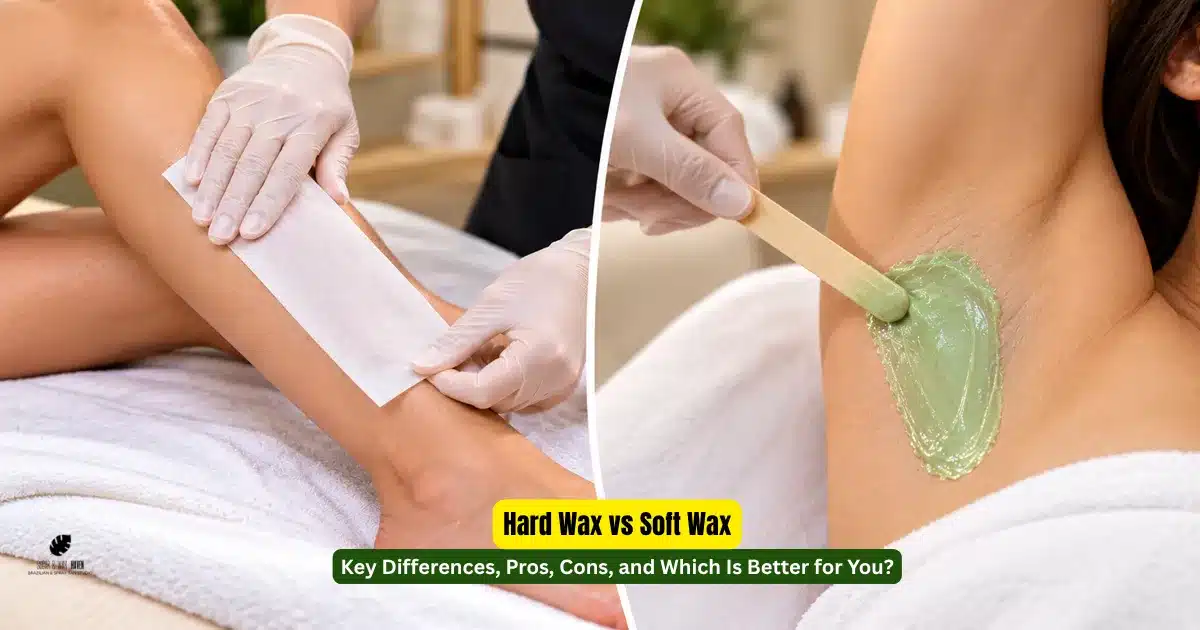
Choose hard wax for sensitive areas such as the bikini area, underarms, and face. It grips only the hair, not the skin, so it causes less irritation and pain. Choose soft wax for large, less sensitive areas like legs, arms, and back, where it covers more ground quickly and removes fine hair efficiently.
Hard wax hardens on the skin and is removed without a strip. Soft wax stays tacky and needs a cloth or paper strip to pull off. That one distinction changes everything. It affects which area suits it, how much it hurts, and how sensitive skin reacts.
In Arizona, we use both in the same appointment almost every day. A Brazilian wax at our Tempe studio typically starts with hard wax for the bikini area, then shifts to soft wax if a client wants their full legs done in the same session.
Knowing which wax works for which area is not optional- it directly affects how your skin feels the next day. Here is everything you need to understand both options before you book.
Hard Wax vs Soft Wax: Key Differences
The key difference between hard wax and soft wax is how they remove hair. Hard wax hardens on its own and is peeled off without a waxing strip. It adheres only to the hair, not the skin. Soft wax stays liquid, requires a strip to remove, and bonds to both hair and skin, covering larger treatment areas faster.
| Feature | Hard wax | Soft wax |
| Removal method | Peeled off once hardened. No strip needed | Removed using a cloth or paper strip |
| Skin adhesion | Bonds primarily to hair, not skin | Bonds to hair and surrounding skin |
| Application temperature | 104-113°F (40-45°C) | 98-104°F (37-40°C) |
| Layer thickness | Thicker layer (2-3 mm) | Thin layer applied in the direction of hair growth |
| Best body areas | Bikini, underarms, face, upper lip, chin | Legs, arms, back, chest, large flat areas |
| Pain level | Lower on sensitive areas | Lower on less sensitive, large areas (often higher on sensitive zones) |
| Sensitive skin | Better option | Can cause more surface irritation |
| Reapplication on same area | Can reapply once if needed | Not recommended, risks skin lifting/irritation |
| Speed for large areas | Slower | Faster |
| Cost | Generally higher per session | More economical for large areas |
| Best hair type | Coarse or short hair | Fine to medium hair |
| Hair length | Works well on shorter, coarse hair | Usually better with slightly longer hair |
| Precision | Better for small, detailed areas | Better for broad areas |
| Wax consistency | Sets firm before removal | Stays soft during removal |
| Exfoliation | Less surface exfoliation | More surface exfoliation |
| Hair removal efficiency | Excellent for coarse, short, stubborn hair | Works well for fine to medium hair |
Both waxing types have unique benefits, and the right choice depends on the waxing benefits you want, the area being waxed, your hair type, and your skin sensitivity.
What Is Hard Wax?
Hard wax is a stripless hair removal wax applied warm to the skin. It hardens as it cools, gripping only the hair shaft and not the surrounding skin. Once firm, it is removed by hand. It is the preferred wax type for sensitive, small, or contoured areas of the body.
How Hard Wax Works
Hard wax is heated until it reaches a spreadable consistency, then applied in a thick layer in the direction of hair growth. As it cools over 30-45 seconds, it contracts around the hair shaft. The esthetician then flicks up the edge and quickly removes it against the direction of hair growth, pulling the hair out from the root.
- The esthetician preps the skin with a pre-wax cleanser and light powder to remove moisture and oil.
- Apply hard wax at 104-113°F (40-45°C), thick enough to hold its shape.
- The wax firms up over 30-45 seconds. Edges turn matte- that is the signal it is ready.
- Lift the edge and pull the wax back quickly, firmly, and parallel to the skin.
- Press the treated area with a clean hand to soothe the skin immediately after removal.
- Remove any remaining residue with a post-wax oil.
Benefits of Hard Wax
Hard wax offers gentle hair removal with less surface irritation and no strips. It works especially well on coarse hair and sensitive areas.
Here are the main benefits of hard wax:
- Gentle on Skin: Adheres mainly to hair, causing less surface trauma.
- Less Pain: Often more comfortable than soft wax on sensitive areas. Most clients rate it 3-4/10 versus 6-7/10 for soft wax on the same area.
- No Wax Strips: Removes directly without paper or fabric strips.
- Coarse Hair: Removes short, thick hair effectively.
- Sensitive Areas: Suitable for the face, underarms, and bikini area.
- Hair From Root: Pulls hair from the root for longer-lasting smoothness.
- Smooth Skin: Can leave skin feeling smooth after removal.
- Small Areas: Works well for precise areas and smaller sections.
- Fewer Shaves: Root removal means less frequent shaving between sessions.
- Reapplication: Can be reapplied to the same area when needed.
Drawbacks of Hard Wax
The drawbacks of hard wax include slower application, discomfort, irritation, burn risk, ingrown hairs, and higher costs. It also requires proper hair length and technique.
Here are the drawbacks of hard wax:
- Slower for Large Areas: Takes longer on full legs, backs, and other large areas.
- Can Be Painful: May sting, especially on sensitive skin.
- Temporary Irritation: Can cause redness or mild skin irritation.
- Burn Risk: Wax that is too hot can burn the skin.
- Ingrown Hairs: May cause ingrown hairs in some people.
- Needs Enough Hair: Hair must be long enough for the wax to grip properly.
- Requires Proper Technique: Too-thin wax may break; too-thick wax wastes product.
- Fine Hair: Less effective for very fine hair across large, flat areas.
- Skin Sensitivity: May not suit people with certain skin conditions or sensitivities.
- Higher Cost: Can cost more per session than soft wax, especially for large areas.
Hard Wax Is Usually Best For
Hard wax works best on small, sensitive, or contoured areas. Such as Brazilian and bikini waxing, underarms, face (brows, upper lip, chin), and the nose. These are the zones where skin adhesion causes the most pain and damage.
What Is Soft Wax?
Soft wax, also known as strip wax, is a hair-removal wax applied in a thin layer and removed with a cloth or paper strip. It stays tacky on the skin, so the strip sticks to the wax and pulls it off quickly. This removes the hair from the root along with some surface skin. Soft wax works best on large, flat areas like the legs and arms.
How Soft Wax Works
Soft wax adheres to hair and removes it from the root when pulled away against hair growth. It works with waxing strips.
- Clean the Skin: Start with clean, dry skin. Avoid oils and lotion.
- Apply Soft Wax: Spread a thin layer in the direction of hair growth.
- Use a Waxing Strip: Place the strip over the wax and smooth it down firmly.
- Pull Against Growth: Hold the skin taut and quickly pull the strip back against hair growth.
- Remove Hair From Root: The wax grips the hair and pulls it from the root.
- Reduce the Sting: Press your hand firmly on the skin immediately after pulling the strip.
- Remove Wax Residue: Use post-wax oil to clean leftover wax.
- No Special Preparation: Clean, dry skin and sufficient hair length are generally all you need.
Benefits of Soft Wax
Soft wax removes hair efficiently from large areas while exfoliating the skin. It works especially well for fine hair and longer-lasting smoothness.
Here are the benefits of soft wax:
- Large Areas: Works well on legs, arms, back, and other large areas.
- Root Hair Removal: Removes hair from the root for longer-lasting results than shaving.
- Fine Hair: Works well on fine hair and removes it effectively.
- Quick Removal: Waxing strips remove hair from larger areas at once.
- Smooth Skin: Removes hair and some surface dead skin cells.
- Versatile Use: Suitable for different body areas based on skin and hair type.
- Easy Application: Waxing strips make application and removal straightforward.
- Cost-Effective: Can take less time and use less product for larger areas.
- Simple Preparation: Requires clean, dry skin and sufficient hair length.
Drawbacks of Soft Wax
Soft wax can cause more skin irritation and discomfort because it adheres to both hair and skin. It also requires careful removal and extra supplies.
Here are the drawbacks of soft wax:
- More Skin Irritation: Bonds to both hair and skin, which can irritate sensitive skin.
- No Reapplication: Should not be reapplied to the same area because it may damage or irritate skin.
- More Discomfort: Pulls against the skin during removal, which can feel more uncomfortable.
- Sticky Residue: Often leaves residue that requires oil or wax remover.
- More Supplies: Requires a wax warmer, applicator sticks, and post-wax products.
Soft Wax Is Usually Best For
Large, less reactive areas, such as legs, arms, chest, and back. Each strip covers more ground per pull, so the wax service moves faster and costs less than using hard wax over the same surface.
Hard Wax vs Soft Wax for Different Body Areas
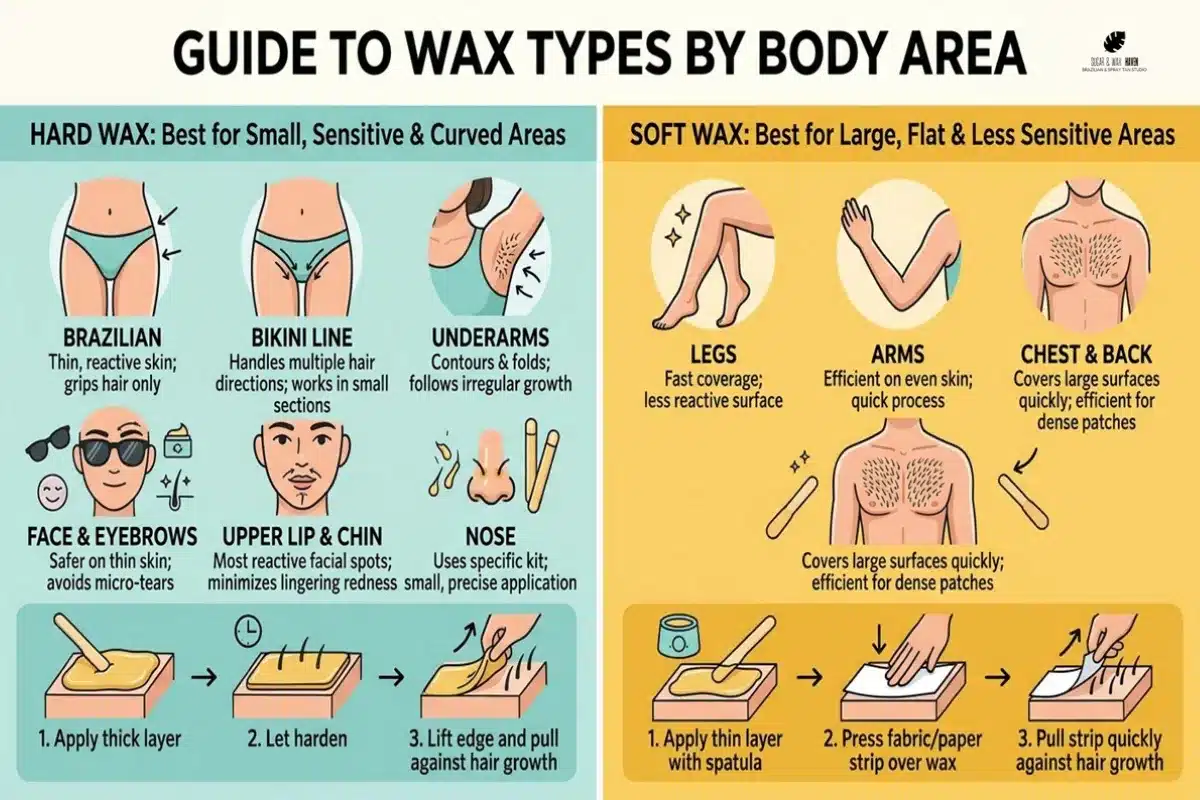
Body area is the first thing to consider when choosing which wax to use. Sensitive, small, or curved zones need hard wax. Large, flat areas suit soft wax because it moves faster and covers more ground per strip.
Brazilian Wax
For a Brazilian wax, hard wax is the only real option here. Bikini skin is thin and reactive, and soft wax pulls it along with the hair. Hard wax grips just the hair and leaves the skin alone.
Bikini Wax
Hard wax handles the bikini line better. Hair here grows in multiple directions, which strips can’t follow. Hard wax works in small sections and cleanly adapts to each direction. If you are choosing among different types of bikini wax, hard wax holds up better than the others.
Also, understanding the process of how to do a Brazilian wax gives you valuable ideas to make better decisions
Underarms
Hard wax, always. Underarm skin folds, contours, and has hair growing in at least three different directions. A strip can’t follow that shape well. Understanding the underarm waxing process will help you know what to expect at your appointment.
Face and Eyebrows
Hard wax is safer on the face. Facial skin is already thin from daily sun and product exposure. Soft wax here can lift skin cells and cause micro-tears, especially if you use retinoids. For anyone curious about how to wax their face, hard wax is the right starting point.
Upper Lip and Chin
Hard wax only. These two spots are the most reactive on the face. The skin above the lip is paper-thin, and soft wax redness here can stick around for hours.
Legs
Soft wax is the go-to for legs. The skin is less reactive, the surface is flat, and each strip covers a wide section fast. A full leg wax typically wraps up in 30 to 45 minutes.
Arms
Same logic as legs. Arm skin is even and less sensitive, so soft wax moves through it efficiently. Hard wax here is slow and rarely worth it unless the client has coarse arm hair or very reactive skin.
Chest and Back
Soft wax covers these large areas quickly. The chest is slightly more sensitive near the sternum, so that spot sometimes calls for hard wax instead. For men with dense back hair, hard wax works better on the thickest patches.
Nose
Hard wax only, using a nose wax kit specifically made for this. Small pre-measured sticks go into the nostril, firm up, and come out in one pull. Soft wax is never used inside the nose.
Quick Body‑Area Rule Table
| Body area | Usually better choice | Why |
| Brazilian | Hard wax | Sensitive skin and coarse hair |
| Bikini | Hard wax | Precision and sensitivity |
| Underarms | Hard wax | Sensitive, curved area |
| Face | Hard wax | Gentle, precise application |
| Eyebrows | Hard wax | Small, detailed area |
| Upper lip | Hard wax | Sensitive, small area |
| Chin | Hard wax | Precision and coarse hair |
| Legs | Soft wax | Fast coverage |
| Arms | Soft wax | Efficient for large areas |
| Chest | Soft wax | Large surface area |
| Back | Soft wax | Faster large‑area removal |
| Stomach | Soft wax | Efficient coverage |
| Fingers/toes | Hard wax | Small, precise areas |
| Neck | Hard wax | Sensitive, precise area |
Hard Wax vs Soft Wax for Different Hair Types
Hair type matters more than most people expect. Hard wax works on coarse, short, and multi-directional hair. Soft wax handles fine hair more efficiently across large, flat areas.
Coarse Hair
Hard wax grips thick hair shafts cleanly. Soft wax strips often break coarse hair at the surface rather than pulling it from the root. Surface breakage is the main reason coarse-haired clients get more ingrown hairs after soft wax sessions.
Fine Hair
Soft wax picks up fine hair better over large areas. The thin application layer bonds to fine strands quickly without needing extra pressure. For fine hair on legs or arms, soft wax is simply faster and more consistent.
Short Hair
Hard wax can grip hair at 1/4 inch (6mm). Soft wax at that length often slides off without cleanly removing anything. If you are unsure about the right length before your appointment, how long hair has to be to wax is worth knowing.
Dense Hair
Dense hair needs hard wax. The thicker application layer wraps around tightly packed follicles without thinning out mid-section. Soft wax strips on dense growth often lift without taking the hair, which forces re-application and irritates the skin.
Hair Growing In Different Directions
This is where hard wax has a clear edge. Bikini and underarm hair rarely grows in one direction. It angles sideways, upward, and diagonally in the same small zone. Hard wax lets us apply it section by section, matching each direction. Soft wax strips work in one direction per pass, leaving the rest untouched.
Ingrown-Prone Hair
Hard wax is the better long-term choice if ingrowns are a recurring issue for you. It pulls from the root without dragging the skin’s surface, so the follicle heals more cleanly.
The American Academy of Dermatology notes ingrown hairs are most common with coarse, curly hair- the exact hair type hard wax handles best. Consistent waxing aftercare starting 48 hours post-appointment noticeably reduces the frequency of ingrown hairs.
Hard Wax vs Soft Wax Aftercare
Same rules for both. That is, skip heat, friction, and active skincare for 24-48 hours after. Where they differ is which body part needs more attention and why.
Hard wax areas are the bikini, underarms, and face. It stays sensitive for the first 12-24 hours. Soft-waxed areas like legs just dry out quickly, so moisture is the main concern.
Hard Wax Aftercare (Bikini, Underarms, Face)
- No hot baths, saunas, or steam for 24 hours. Heat keeps follicles open, which quickly leads to irritation.
- Wear loose underwear or nothing tight over the area. Friction right after waxing is what causes most of those little bumps people blame on the wax itself.
- Apply fragrance-free aloe or an azulene post-wax lotion. Both calm the skin without sitting heavy on the pores.
- Stay off retinoids and exfoliants on the face for 48 hours. The skin barrier is already thinner after waxing- acid on top makes it worse.
- Begin gentle exfoliation 48-72 hours after the appointment. This is what actually prevents bikini and underarm ingrown hairs from forming, not any cream.
- Keep the waxed skin out of direct sun for 24 hours. Waxed skin burns at lower UV exposure than unwaxed skin does.
Soft Wax Aftercare (Legs, Arms, Back)
- Wait 24 hours, then moisturize. Soft wax pulls a fine layer of dead skin off with the hair, and legs feel tight and rough by the next day if you skip this.
- Skip the gym for a full day. Sweat sitting in freshly opened follicles on the legs causes small breakouts- not dangerous, just annoying and preventable.
- After a back or chest wax, wear something loose on the way home. Tight fabric rubbing the skin for two hours undoes a clean result.
- Start light exfoliation on day two or three. It keeps regrowth from coming up sideways instead of straight.
- No self-tanner for 48 hours. The skin absorbs the product more quickly right after waxing, so you will get uneven color almost every time if you apply too soon.
Understanding waxing aftercare helps you maintain longer-lasting results, smoother skin, and a more comfortable experience. It also shows you what to do yourself after waxing.
Can You Use Hard Wax and Soft Wax in the Same Appointment?
Yes, and most good estheticians do it without thinking twice. Hard wax is applied to the bikini area and underarms. Soft wax goes on the legs. Different areas, different wax, same appointment.
At Sugar Wax Haven, a Brazilian plus half-leg wax almost always runs this way. The esthetician finishes the intimate area with hard wax, switches to soft wax for the legs, and cleans the applicator between sections. Nothing complicated about it.
If a salon tells you they use one wax for everything, ask why. There is no single wax that works equally well on your bikini line and your calves. That is just not how skin and hair behave across the body.
Hard Wax vs Soft Wax: Which Is Better for Beginners?
For your first salon appointment, hard wax is the easier experience in sensitive areas. The bikini zone and underarms are where most first-timers tense up, and hard wax is genuinely less painful there. It grips the hair, not the skin.
Tell your esthetician two things before you start: what medications you take (especially retinoids) and which areas you are most nervous about. That is all they need to adjust.
For at-home beginners, start with soft wax on the legs. The strip method is more forgiving on a flat surface. Hard wax at home needs precise heat control, and getting that wrong on the bikini area is a bad first experience. We see the results of those mistakes regularly. Legs first, build confidence, then move on.
How to Choose Between Hard Wax and Soft Wax
Small area, sensitive skin, or hair going in different directions? Hard wax. Large, flat, less reactive area? Soft wax. Not sure? Tell your esthetician where it hurt last time and let them decide. That is what they are there for.
Step 1: Start With the Area
This one question answers most of it. Bikini, underarms, upper lip, chin, nose, brows for hard wax. Legs, arms, back, chest for soft wax. Face also hard wax. You rarely need to think past this step.
Step 2: Be Honest about Your Skin
If your skin turns red fast, stays irritated for days, or reacts to almost everything. Lean toward hard wax, even on legs. Reactive skin does not handle soft wax well. We have seen clients switch to hard wax on legs after soft wax kept leaving redness that lasted three days. The extra time is worth it for skin that just does not settle quickly.
Step 3: Think about Your Hair
Thick, dense, or short hair? Hard wax grips it better. Fine hair spread across a large area? Soft wax picks it up faster and more cleanly. Bikini hair varies a lot between clients, some have fine growth, some have coarse. That alone can change the wax type even for the same service.
Step 4: Factor in Time and Cost
A full-body appointment using only hard wax takes noticeably longer and costs more. Soft wax on large areas like legs is faster, that is simply how it works at scale. Most estheticians already plan around this, but if you are short on time, mention it upfront.
Step 5: Tell Your Esthetician What Happened Before
This is the most useful thing you can do. If soft wax on a certain area gave you hives, or took days to calm down, say that before the appointment starts, not after. That one piece of information changes the product, the prep, and the aftercare plan. It is also how we catch problems before they repeat.
Common Waxing Mistakes to Avoid
We see the same damage patterns weekly at Sugar Wax Haven, almost always from the same avoidable mistakes. Most happen at home. A few happen in salons that rush. Here is what to watch for.
- Too-Short Hair: Under 1/4 inch (6mm), wax snaps the hair instead of pulling from the root. Wait longer between sessions.
- Wax Too Hot: Test on your inner wrist first. If it stings on contact, it needs more cooling time.
- Soft Wax On Sensitive Zones: Bikini, underarms, and face need hard wax. Soft wax grabs skin, not just hair.
- Double-Passing With Soft Wax: One pass only. A second strip on the same spot risks lifting actual skin.
- Pulling The Strip Upward: Keep it fast and flat, parallel to the skin. Pulling at an angle bruises and lifts.
- Waxing On Medicated Skin: Tretinoin, Retin-A, and Accutane thin the skin. Waxing over them tears it.
- Skipping Aftercare: Tight clothing and skipped products turn a clean result into bumps within hours.
- Waxing Over Broken Skin: Sunburn, active breakouts, eczema flares — none of these are waxable. Skip the appointment.
FAQs
Hard Wax vs Soft Wax: Which Hurts Less?
Hard wax hurts less. It grips the hair, not your skin, so the sting is quick and mild. Soft wax pulls the skin surface too, which hits harder on thin, sensitive areas.
Which Wax Is Better for Sensitive Skin?
Hard wax. It sticks to hair only, so your skin takes far less of the hit. We see soft wax leave noticeable redness on reactive skin almost every time.
Which Is Better for the Face?
Hard wax, no question. Facial skin is thin. Soft wax grabs the skin along with the hair, and on the face that means redness, sometimes irritation that lingers for hours. If you use retinol or any acid, this matters even more.
When Should You Avoid Waxing?
If you use tretinoin, Retin-A, or Accutane, do not wax. These thin your skin, and waxing will tear it. Same rule for sunburn, open skin, rashes, or eczema. Diabetic clients should clear it with their doctor first. And yes, waxing during your period hurts more, your pain sensitivity actually goes up.
How to Use Hard Wax Safely?
Heat it to 104113°F, test on your wrist first. Apply a thick layer with the hair growth, wait 3045 seconds until the edges go matte, then pull fast and flat against the growth. Hold the skin taut. New applicator for each section, no double-dipping.
What Temperature Should Hard and Soft Wax Be?
Hard wax: 104113°F. Soft wax: 98104°F. Warm on your wrist is right. Hot means it will burn. Test before every single application, not just the first dip.
Book Your First Wax the Right Way
Most waxing frustrations come down to one thing: wrong wax, wrong area. Hard wax on sensitive zones. Soft wax that covers the ground fast. That choice alone changes how your skin feels the next 48 hours.
At Sugar Wax Haven in Tempe, our estheticians make that call before the appointment starts. We see what works daily. Bikini area, underarms, and full legs each get the wax that suits it. The first Brazilian is on promo for new clients. We are at 3030 S Rural Rd, Suite 107. Call or book our services online.